To Protect the Nishitetsu Group’s Food Safety
In order to address food safety for our customers, we have established the Food Subcommittee, a safety management organization for all Group companies that handle food products, including supermarkets, hotels, restaurants, and food plants.
In line with the Nishitetsu Group Food Safety Policy (compliance with food-related laws and regulations, promotion of communication on food safety, and establishment of a system to ensure food safety), we formulate annual plans, check implementation status, and provide guidance for improvement through kitchen hygiene inspections.
Facilitating Internal and External Communication
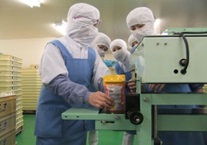
In addition to external hygiene inspections, monthly voluntary hygiene inspections are conducted with each business location to strengthen hygiene management. In 2021, we introduced the HACCP-Based Food Hygiene System, which has been institutionalized, throughout the company.
We also visit external suppliers and partner companies involved in procurement and manufacturing to inspect hygiene management practices at their factories and food storage facilities. During these visits, we engage in dialogue with on-site managers and exchange information related to food safety, working together to raise overall safety awareness.

Hand washing, which is the basis of hygiene management, is performed according to a manual with hygienic procedures in order to eliminate harmful bacteria. In addition, we frequently wash our hands to prevent cross-contamination of food and cooking utensils.
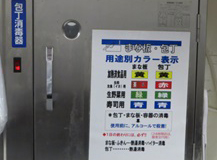
To prevent contamination via foodstuffs, we have color-coded knives, cutting boards, dusters (dishcloths), etc. and use them according to their intended purpose. Furthermore, knives and cutting boards are thoroughly disinfected with alcohol after cleaning.

We strive to provide safe food by thoroughly checking the expiry dates of the food ingredients used, as well as setting and managing our own expiry dates for opened packages.

Experts inspect kitchens and food plants to check sanitary conditions and provide guidance for improvement.
Our group thoroughly prevents the sale and provision of alcoholic beverages to persons under the age of 20. Underage drinking hinders physical growth (sexual function, brain, liver, etc.), and the younger the age at which drinking begins, the higher the risk of developing alcohol dependence, which has a negative impact on health.
As a responsible business operator which recognizes the negative effects that can be caused by drinking, we provide warnings regarding alcohol, promote the sale of non-alcoholic and low-alcohol beverages, and conduct training for our employees.
In our group, to prevent the sale of alcoholic beverages to persons under 20, we are committed to legal compliance, such as by appropriately verifying the age of our customers.
When advertising and selling processed foods, we comply with relevant laws and regulations and strive to ensure that we do not mislead our customers.
We provide training for group companies on appropriate labeling and notifications based on relevant laws and regulations, such as the Food Labeling Act and the Act against Unjustifiable Premiums and Misleading Representations. This ensures that we do not mislead customers when conducting advertising and other activities.